
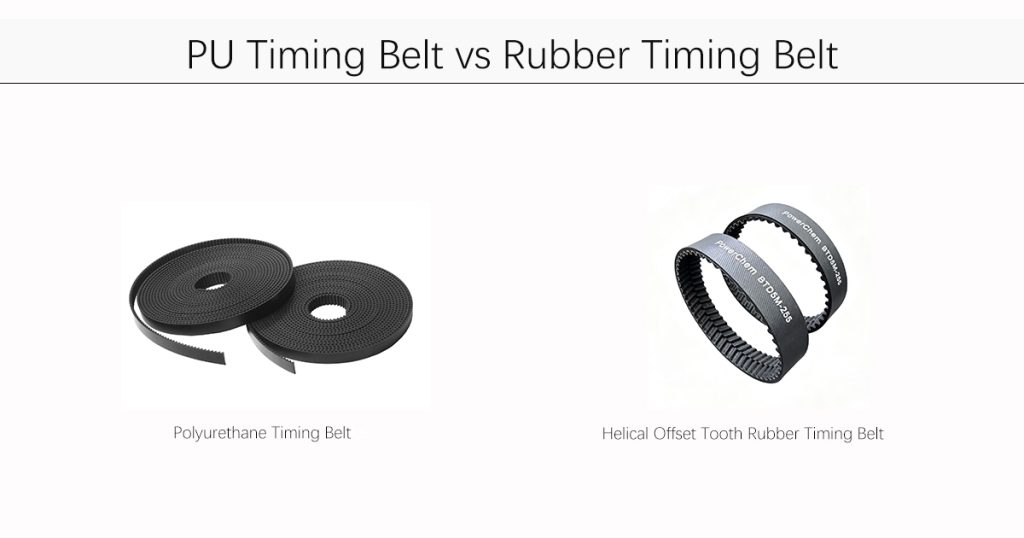
Both polyurethane (PU) and rubber timing belts do the same basic job: they carry torque on a toothed profile without slipping, and they keep the driven shaft in step with the motor. The difference is in how they behave in service — and that difference decides belt life, positioning accuracy and maintenance cost.
The short answer: choose polyurethane when you need precision, abrasion resistance, chemical resistance, high speed, or machined features such as cleats and coatings. Choose rubber when the drive runs hot, wet or steamy, sees heavy shock loads, or simply needs the lowest-cost standard replacement.
This guide compares the two materials on the points that actually matter — stretch, accuracy, temperature, abrasion, chemicals, speed, noise and cost — and ends with a checklist you can use before swapping one type for the other. Figures quoted are typical of industrial catalogues; always confirm against the manufacturer’s datasheet for the exact profile you are ordering.
The material difference in one minute
Polyurethane (PU) timing belts use a thermoplastic polyurethane body, usually around 92 Shore A, reinforced with a steel or aramid tension member. Because the body is thermoplastic, it can be welded into an endless loop, machined, ground and bonded — which is why PU belts are available as open-end roll, welded endless, cleated, coated or V-guided belts.
Rubber timing belts use a neoprene (CR) or HNBR body with glass or aramid cord, vulcanised in a mould. The material is more elastic and more forgiving, and the process is efficient in high volumes — which is why rubber dominates automotive and high-volume general drives.
That single material difference explains almost every practical difference below.
Side-by-side comparison
| Property | Polyurethane (PU) | Rubber (CR / HNBR) |
|---|---|---|
| Tensile strength and power density | High — steel-cord PU carries more load per mm of width | Moderate |
| Stretch under load | Very low with steel cord; set once, run for years | Noticeably higher; periodic re-tensioning is normal |
| Positioning accuracy | Excellent repeatability — no creep, no re-tensioning | Fair: creep and stretch affect repeatability over time |
| Abrasion resistance | Excellent — the main reason PU is used in dry, dusty lines | Lower; wears faster against abrasive product |
| Oil and grease | Excellent resistance | Neoprene: good. HNBR: good |
| Chemical resistance | Good against many oils, greases and solvents; poor against strong acids and alkalis | Depends on compound — always check compatibility |
| Temperature range | Typically −20 to +80 °C (short excursions higher, compound-dependent) | Typically −20 to +100 °C; HNBR grades up to about +120 °C |
| Maximum belt speed | High | Moderate to high |
| Small pulley diameters | Good — PU tolerates high tooth frequency | Good, and more forgiving of slight misalignment |
| Wet, steam or hot-water contact | Not recommended for continuous exposure | Better choice |
| Debris generated | Low — clean running, low dust | Higher in abrasive contact |
| Hygiene and food contact | White PU grades available with low shedding | Possible, but needs care in cleaning cycles |
| Making it endless | Open-end roll, or welded endless in any length | Moulded endless only — lengths come from tooling |
| Machining: cleats, coatings, grinding | Easy and common | Limited |
| Relative cost | Higher per belt | Lower in standard sizes and volumes |
| Typical applications | Linear actuators, 3D printers, pick-and-place, packaging, wood, glass, ceramic, textile | Automotive, general power transmission, hot or wet environments |
When polyurethane is the better choice
1. Accurate positioning and no re-tensioning
A steel-cord PU belt barely stretches. On a linear actuator or a pick-and-place axis this means the home position stays where it was set, backlash does not drift, and nobody has to climb into the machine to re-tension the belt every few months. Rubber belts do stretch, and that stretch shows up as positioning error on a servo axis.
2. Abrasion and dust
In woodworking, glass, ceramic and panel handling, abrasive dust is the main killer of belts. PU resists abrasion far better than rubber, and it does not shed black residue onto the product.
3. Oils, greases and many chemicals
PU is the safer default where the belt sees lubricant mist, cutting fluid or cleaning agents. Rubber compounds vary; some are fine, some swell. If you are unsure, ask for a chemical compatibility check before ordering.
4. High speed and small pulleys
PU belts handle high tooth frequency and small pulley diameters well, which is why they are common on high-speed packaging and labelling machinery.
5. Machined features
Cleats, lugs, side walls, PU coating, back grinding and V-guides can all be added to a PU belt. That flexibility is hard to match with moulded rubber.
6. Clean running and food areas
White PU grades run clean, generate little debris and are easy to wipe down — a common choice for food and medical packaging lines, subject to the specific grade’s certification.
When rubber is the better choice
1. Heat
Above roughly 80 °C, PU starts to lose its advantage. Neoprene is comfortable to about 100 °C and HNBR grades go higher. Near a heat source, in an oven or on an engine, rubber is the correct answer.
2. Shock loads and misalignment
Rubber’s elasticity absorbs shock and tolerates slight misalignment and pulley wear. On a drive with frequent jams or reversing loads, that forgiveness extends life.
3. Wet, steamy or hot-water environments
Continuous moisture is where PU is weakest. Washdown areas, steam tunnels and hot-water contact favour rubber.
4. Standard replacement cost
For common profiles and sizes, moulded rubber belts are usually cheaper per piece. If the drive is not precision-critical and the temperature is moderate, rubber is the economical choice.
5. Automotive and general drives
Cam drives, timing on engines and general industrial transmissions are dominated by rubber for good reasons: heat, cost, volume and proven history.
Can you swap a rubber belt for a PU belt? Check these six points first
- Pitch and tooth profile must match the pulleys exactly. The same pitch in a different tooth form (for example AT versus HTD) will not run correctly.
- Width and rated load: PU usually carries more per millimetre, but confirm the rating for your speed and pulley size rather than assuming.
- Temperature at the belt, not at the motor: measure it. Above about 80 °C, stay with rubber.
- Chemical exposure: oils, coolants, cleaning agents and washdown. PU is not the right answer for continuous water contact.
- Tensioner and take-up: a PU belt needs far less take-up travel. If your frame only works with a stretched belt, check the geometry.
- Pulley condition: worn or corroded pulleys will destroy a new belt of either material. Inspect them first.
If all six pass, a PU belt is usually a direct improvement in life and accuracy. If any one fails, the belt will fail — and it will look like a belt quality problem when it is really an application mismatch.
Quick decision guide
| If your drive… | Choose |
|---|---|
| Must hold position accurately, run fast, or is a linear axis | Polyurethane |
| Sees abrasive dust, chips or panel edges | Polyurethane |
| Sees oil mist, cutting fluid or most greases | Polyurethane |
| Needs cleats, coatings, V-guides or a welded endless loop | Polyurethane |
| Runs above about 80 °C, or near a heat source | Rubber |
| Is regularly wet, steamed or washed down | Rubber |
| Sees heavy shock loads, jams or rough handling | Rubber |
| Is a standard, low-precision, cost-sensitive drive | Rubber |
Frequently asked questions
Are PU belts stronger than rubber belts?
Per millimetre of width, a steel-cord PU belt is usually rated higher than a comparable rubber belt, and it stretches far less. That said, the correct comparison is the rated capacity at your speed, pulley size and tooth count — use the catalogue rating, not the material alone.
Which belt is quieter?
Tooth profile and pulley size matter far more than the body material. A curvilinear or helical offset tooth profile running on a well-matched pulley will be quieter than a straight trapezoidal tooth in either material. If noise is your problem, change the profile first.
Do PU belts need re-tensioning?
Normally no. With a steel tension member, the belt is set once at installation. Rubber belts stretch in service and are re-tensioned periodically, which is one reason PU is preferred on positioning axes.
Can a PU belt run at 100 °C?
Not continuously in most standard compounds. Short excursions above 80 °C are sometimes acceptable, but for sustained high temperature choose an HNBR rubber belt instead.
Are PU belts food safe?
Certain white PU grades are made for food contact and are certified accordingly. The belt material is only part of it — cleats, coatings and the joint must meet the same standard. Ask for the certificate for the exact configuration.
Which one lasts longer?
In the right application, both last for years. In the wrong one, both fail quickly: PU in continuous heat or water, rubber in abrasive dust or on a precision axis. Material selection decides life more than belt quality does.
Choosing a belt for your drive
SilentBelt supplies polyurethane timing belts in T, AT, HTD, STD, RPP and DualSync helical offset tooth profiles, as open-end roll or welded endless, with cleats, coatings and V-guides to drawing. If you tell us the pitch, width, centre distance, load and operating temperature, we will tell you whether PU is the right material for that drive — and if it is not, we will say so.
Browse the PU timing belt range on our products page, or send your drawing and operating conditions for a recommendation and quotation.